Is Rich House Poor House On Tonight? Unpacking the Enduring Appeal of Channel 5's Social Experiment
For viewers asking, "Is Rich House Poor House On Tonight?", the specific broadcast schedule can vary. However, the powerful human stories and profound insights offered by this Channel 5 series mean that episodes, both new and old, continue to resonate deeply with audiences. Is Rich House Poor House On Tonight - Article 1 and Is Rich House Poor House On Tonight - Article 2 delve into other impactful stories, but today we explore further poignant examples that highlight why this social experiment remains so compelling. The show's premise is simple yet revolutionary: two families from vastly different financial backgrounds swap homes, budgets, and lifestyles for a week, challenging their perceptions of money, happiness, and privilege.
The core of Rich House Poor House lies in its ability to strip away preconceptions and reveal the raw realities of life at opposite ends of the economic spectrum. It's an immersive journey that leaves an indelible mark on both the participants and the viewers, forcing us all to confront difficult questions about wealth disparity in modern society.
When Budgets Collide: Skye Walker's Journey to Self-Belief
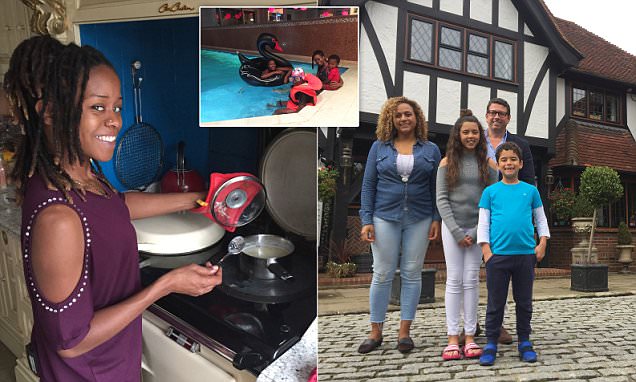
One of the most striking episodes featured Skye Walker, a single mother of three children – Kareem, Ashani, and Riahiema – from Lewisham. Skye's life was a testament to extreme resourcefulness and resilience. Earning a living through cleaning jobs, she had to stretch a meagre £170 a week after bills to support her family. Every penny counted, and her constant quest for free activities around Lewisham to keep her children entertained painted a vivid picture of the financial pressures she faced daily. For many watching, Skye embodied the quiet determination of countless parents navigating similar economic landscapes across the UK.
The opportunity arose for Skye and her family to swap lives with the affluent Sethard-Wrights of Bromley. Belinda Sethard-Wright, 46, a successful businesswoman, and her husband Matt, 47, who works in finance, enjoyed a lifestyle unimaginable to Skye. Their £4 million mansion boasted an indoor pool, and their weekly household budget easily exceeded £1,600 – more than Skye had in ten weeks. The contrast couldn't have been starker.
For Skye and her children, the week was a revelation. They experienced swimming lessons in the Sethard-Wrights' private indoor pool, a luxury far removed from their usual routines. The children even had the chance to do their homework on a brand new computer and receive private maths tuition, offering a glimpse into the educational advantages wealth can provide. It wasn't just about material possessions; it was about the freedom from constant financial anxiety, the ability to say 'yes' to opportunities without second-guessing every cost.
Meanwhile, Belinda Sethard-Wright found herself plunged into Skye's financial reality. Accustomed to a generous budget, she quickly realised the severe limitations of £170 a week. Panic set in as she struggled to make ends meet, discovering that the money would run out by Friday. This eye-opening experience deeply affected Belinda, who herself had grown up on a council estate. She spoke of a "hollow hole" in her chest, a profound emotional response to the straitened circumstances, and declared Skye a "wonder woman" for her incredible ability to manage and thrive under such pressure.
The swap left Skye inspired, resolving to start her own business in a bid to give her children a "happier life," proving that a taste of what's possible can be a powerful catalyst for change.
A Lifeline and a Lesson: Geri's Story and Debi Clarke's Empathy
Another incredibly moving episode highlighted the struggles of Geri, a single mother living on a shockingly low £57 a week after bills, alongside her teen daughter Scarlett. Geri worked part-time as a cook at a nursery, while also caring for her elderly father. Her past was marked by hardship: divorcing when Scarlett was four, the pair had moved house eight times and even faced homelessness during a difficult period. Now renting a small ground-floor flat in Shoreham-by-sea, Geri's resourcefulness shone through in her "house proud" efforts, with most of her furniture being up-cycled or acquired from a tip.
Despite the challenges, Geri was a woman of dreams and ambition. She had tried various jobs to fit around motherhood, recently qualifying as a florist, and harboured a long-term dream of owning a cafe that also sold flowers. Her greatest hope was for Scarlett, currently sitting her A-Levels, to attend university. Geri's poignant admission, "I feel that when you are on minimum wage and you've living this way, it's like a trap and once you're in it it seems almost impossible to get out of," resonated with countless viewers.
Their swap partner was millionaire businesswoman Debi Clarke. Debi's life was a stark contrast, spent in a luxurious 18th Century farmhouse in the Kent countryside, complete with four acres of land, and even a glamorous villa in Spain. Her weekly budget for household expenses easily reached £1,500.
Yet, Debi's journey to wealth wasn't one of inherited privilege. She openly admitted, "I wasn't born with a silver spoon in my mouth, as you can probably tell by the accent," having left school with no qualifications and drifting through hundreds of jobs, from dental nurse to making false teeth. This personal history of overcoming adversity made her experience of Geri's life particularly impactful.
The swap deeply affected Debi. Witnessing firsthand the immense struggle of managing on £57 a week brought her to tears. In an incredibly emotional moment, she offered Geri a "lifeline," a gesture of profound empathy and a testament to the show's power to bridge divides. It highlighted that while money provides comfort, a shared humanity and understanding can transcend financial boundaries, offering hope and practical support that extends far beyond the duration of the swap.
Beyond the Swap: Lessons in Empathy, Resilience, and Aspiration
The stories of Skye, Geri, and their affluent counterparts underscore the fundamental questions Rich House Poor House poses: Can money truly buy happiness? And what lessons can we glean from these extraordinary exchanges?
- The Myth of Effort: Often, there's a misconception that those struggling financially simply aren't working hard enough. These episodes powerfully dismantle that myth, showcasing the immense effort, ingenuity, and sheer hard work required just to survive on a minimal budget. Skye's relentless search for free activities and Geri's multi-faceted work and caregiving responsibilities are prime examples.
- The Price of Peace of Mind: For the less affluent families, a taste of financial freedom often reveals that what they crave most isn't extravagant luxury, but simply the absence of stress. The ability to afford basic necessities without constant worry, to provide opportunities for their children, and to plan for the future without immediate financial dread, is a profound luxury in itself.
- Renewed Perspective: For the wealthier participants, the experience is almost always humbling. Belinda's "hollow hole" and Debi's emotional offer of a lifeline demonstrate a deep reconnection with the realities faced by millions. It often instils a renewed appreciation for their own good fortune and a profound respect for the resilience of those managing on so little. These moments of genuine empathy are what make the show so compelling.
- Igniting Aspiration: The brief exposure to a different world often ignites or re-ignites ambitions. Skye's resolution to start a business and Geri's continued dreams for Scarlett and her own cafe are powerful illustrations of how seeing what's possible can fuel the drive to achieve more.
These stories teach us that while money certainly alleviates many stressors and opens doors, it doesn't define a person's worth, intelligence, or capacity for love and resilience. The true value often lies in the connections, the determination, and the human spirit that shines through regardless of the balance in a bank account.
Conclusion: The Enduring Message of Rich House Poor House
Whether you're wondering "Is Rich House Poor House On Tonight?" because you're looking for new episodes or simply want to catch up on powerful past stories, the series consistently delivers thought-provoking television. It's more than just an entertainment show; it's a vital social experiment that peels back the layers of economic disparity, fostering a greater understanding and empathy between different segments of society.
The impact on families like Skye's and Geri's is transformative, offering not just a temporary escape, but often a catalyst for long-term change and renewed hope. For their wealthy counterparts, it's an invaluable lesson in perspective and gratitude. Rich House Poor House reminds us that behind every budget, there's a human story, filled with struggles, dreams, and an incredible capacity for resilience. It challenges us all to look beyond the numbers and see the invaluable human qualities that money simply cannot buy.